
As AI capabilities gradually expand from the cloud to the edge, smart hardware is evolving from passive response toward continuous perception, proactive understanding, and natural feedback. For portable devices such as voice recorders, smart ID badges, body-worn recorders, and AI learning assistants, the user experience is no longer determined solely by the computing power of a single main control chip. Instead, it depends on whether audio, imaging, user-state sensing, display interaction, wireless connectivity, and low-power management can operate together as an efficient and coordinated system.
This solution is designed for a wide range of audio-visual and wearable AI terminals, providing a standardized, modular, and scalable edge AI perception platform. The platform integrates HiSilicon’s high-end audio/video SoCs, AAC MEMS and bone-conduction acoustic components, Yanjing Micro’s ISP, image sensors with on-chip processing capabilities, Syntiant ultra-low-power AI perception chips, and high-refresh-rate touch-enabled e-paper displays. It further incorporates EEG/IMU-based user-state sensing technology, creating a complete technology chain covering environmental perception, user-state perception, hierarchical computing, and local feedback.
The core objective of the platform is not simply to stack components, but to perform hierarchical processing according to the real-time, power consumption, and computing requirements of different tasks. Low-power chips handle always-on monitoring; specialized components perform high-quality signal acquisition and preprocessing; the main SoC handles complex applications and system-level scheduling; and cloud-based large models are accessed when necessary. This approach achieves a better balance among battery life, perception quality, response speed, and product cost.

Core Technology Architecture: From “Single-chip Computing” to “Hierarchical Perception and Collaborative Computing”
Traditional smart terminals often rely on the main SoC to operate continuously, with voice, imaging, recognition, and display tasks concentrated on a single processor. This can result in high standby power consumption, increased thermal-design pressure, and inefficient utilization of computing resources.
This solution adopts a hierarchical architecture that divides the system into six layers: the always-on perception layer, acoustic perception layer, visual perception layer, user-state perception layer, core application computing layer, and low-power interaction layer.
Ultra-low-power Always-On AI Perception: Syntiant Compute-in-Memory Chip
Syntiant chips are designed to handle tasks where the device needs to “always be listening and always be sensing, without requiring the main processor to remain awake.” Their low-power AI architecture is suitable for always-on tasks such as voice wake-word detection, keyword recognition, environmental sound event detection, and basic scene classification.
Only when a meaningful event is detected will the main SoC be awakened to enter a higher-performance computing state.
This design can significantly reduce the average standby power consumption of portable terminals while minimizing unnecessary data uploads and redundant computation. This is particularly important for smart ID badges, body-worn recorders, and wearable devices that need to be worn or operated throughout the day.
Full-Scenario Accoustic Perception: AAC MEMS + Bone Conduction + Speaker
Sound is currently one of the most natural and frequently used input methods for AI terminals. The platform uses high signal-to-noise-ratio MEMS microphone arrays to capture the surrounding sound field and can incorporate bone-conduction pickup according to the product form factor.
MEMS microphones are suitable for scenarios such as meetings, classrooms, and everyday communication. Bone conduction, meanwhile, can extract the wearer’s voice from vibrations generated by the user’s body, improving the usability of the user’s own voice in complex environments such as windy conditions, streets, and construction sites.
On the algorithm side, technologies such as VAD, AGC, AEC, noise reduction, and beamforming can be integrated to provide a more stable input signal for speech recognition, transcription, meeting minutes, and intelligent interaction.
When combined with speakers or other audio output components, the system forms a closed loop of “capture — recognition — understanding — feedback.”
High-definition Intelligent Visual Perception: Computing-Enabled Sensor + Yanjing Micro ISP
The visual subsystem adopts a hierarchical approach combining “front-end Sensor processing + professional ISP.” Sensors with on-chip processing capabilities can perform motion detection, basic image preprocessing, frame selection, and buffering, preventing the main processor from having to continuously process all raw image data.
The Yanjing Micro ISP then performs further processing, including noise reduction, automatic exposure, low-light enhancement, dynamic-range optimization, and video-quality stabilization.
This architecture is particularly suitable for body-worn recorders, smart ID badges, and AI learning assistants. The device can determine in a low-power state whether an image is worth capturing or whether recording is required, and only activate higher-level visual and AI processing after a meaningful event is detected.
User-state Perception: EEG + IMU Feedback Technology
In addition to conventional audio-visual perception, the platform further supports EEG and IMU-based user-state perception, enabling AI terminals not only to understand “what is happening externally,” but also to help determine whether the user is currently in a state suitable for receiving information.
At this stage, a lightweight behind-the-ear EEG solution can be adopted, for example, using 4-channel acquisition synchronized with a 6-axis IMU. This can be used to study states such as attention, potential distraction, fatigue trends, and invalid-signal identification.
The EEG module uses a low-power continuous-acquisition design, with the objective of operating as an auxiliary sensor over extended periods at low power consumption. Signal-quality assessment can also be used to avoid over-interpreting data when motion artifacts are significant.
The role of EEG in this platform is not medical diagnosis, but rather an “enhancer of human-machine interaction reliability.”
For example, when the device determines that the user may not have noticed an important notification, it can repeat the message, slow down the playback, split the message into shorter sentences, or request confirmation. In learning-assistant scenarios, the notification rhythm can be adjusted based on attention trends. In wearable devices such as smart glasses and headphones, the platform can further explore a closed loop of “user-state perception — AI decision-making — audio/visual feedback.”
Core Application Computing: High-End Audio/Video SoC from Hengxuan
Hengxuan’s high-end audio/video SoC serves as the main controller of the complete device, handling the operating system and task scheduling, audio/video encoding and decoding, wireless connectivity, storage, display control, complex AI applications, and interfaces to cloud-based large language models.
By offloading always-on perception, image preprocessing, and other tasks to low-power or specialized chips, the main SoC can focus more of its resources on applications that genuinely require high computing performance.
This division of responsibilities helps reduce average system power consumption, simplify software resource conflicts, and improve overall system stability.
For devices requiring Wi-Fi, Bluetooth, or Cat.1 cellular connectivity, different combinations of communication technologies can also be used to enable flexible switching between local processing and connected services.
Low-Power Human-Machine Interaction: High-refresh-rate Touch e-paper Display
E-paper displays offer excellent visibility under strong light and consume virtually no power when displaying static content, making them highly suitable for AI terminals that need to be worn or carried for extended periods.
With high-refresh-rate and touch capabilities, the display can be used to show operating status, recording summaries, task notifications, learning content, device menus, and AI feedback.
For products that require continuous information display without keeping an LCD or OLED screen continuously illuminated, e-paper displays can significantly reduce the average power consumption of the display system.
Multicolor versions can further use different colors to indicate alerts, priorities, and status levels, improving information recognition efficiency.
How the Platform works: Perception, Decision-making, Activation, and Feedback
Step 1: Low-Power Monitoring
Syntiant, front-end Sensors, or other low-power components continuously monitor sound, motion, and environmental changes. EEG/IMU is used in supported products to assist with user-state perception.
Step 2: Event Triggering
When the system detects keywords, abnormal sounds, motion events, key visual frames, or changes in user state, it determines whether the main SoC needs to be awakened.
Step 3: Multimodal Fusion
The main SoC combines audio, images, time, location, user-state information, and other data to determine the current scenario and task.
Step 4: Edge or Cloud AI Processing
Simple tasks are handled locally whenever possible. When large-model understanding, long-form text summarization, or complex knowledge-based question answering is required, cloud capabilities are accessed through a network connection.
Step 5: Natural Feedback
Speakers, e-paper displays, smartphones, or other terminals provide notifications, summaries, confirmations, and next-step actions, completing the interaction loop.
Modular Product Framework
Based on the technology described above, the platform comprises six independently configurable functional modules:
① Ultra-Low-Power AI Perception Module; ② Full-Scenario Acoustic Module; ③ High-Definition Visual Module; ④ EEG/IMU User-State Perception Module; ⑤ Core Application Computing and Connectivity Module; ⑥ Low-Power Display and Interaction Module.
Not every product needs to include all modules. They can be freely combined according to cost, battery life, size, and target user-experience requirements.
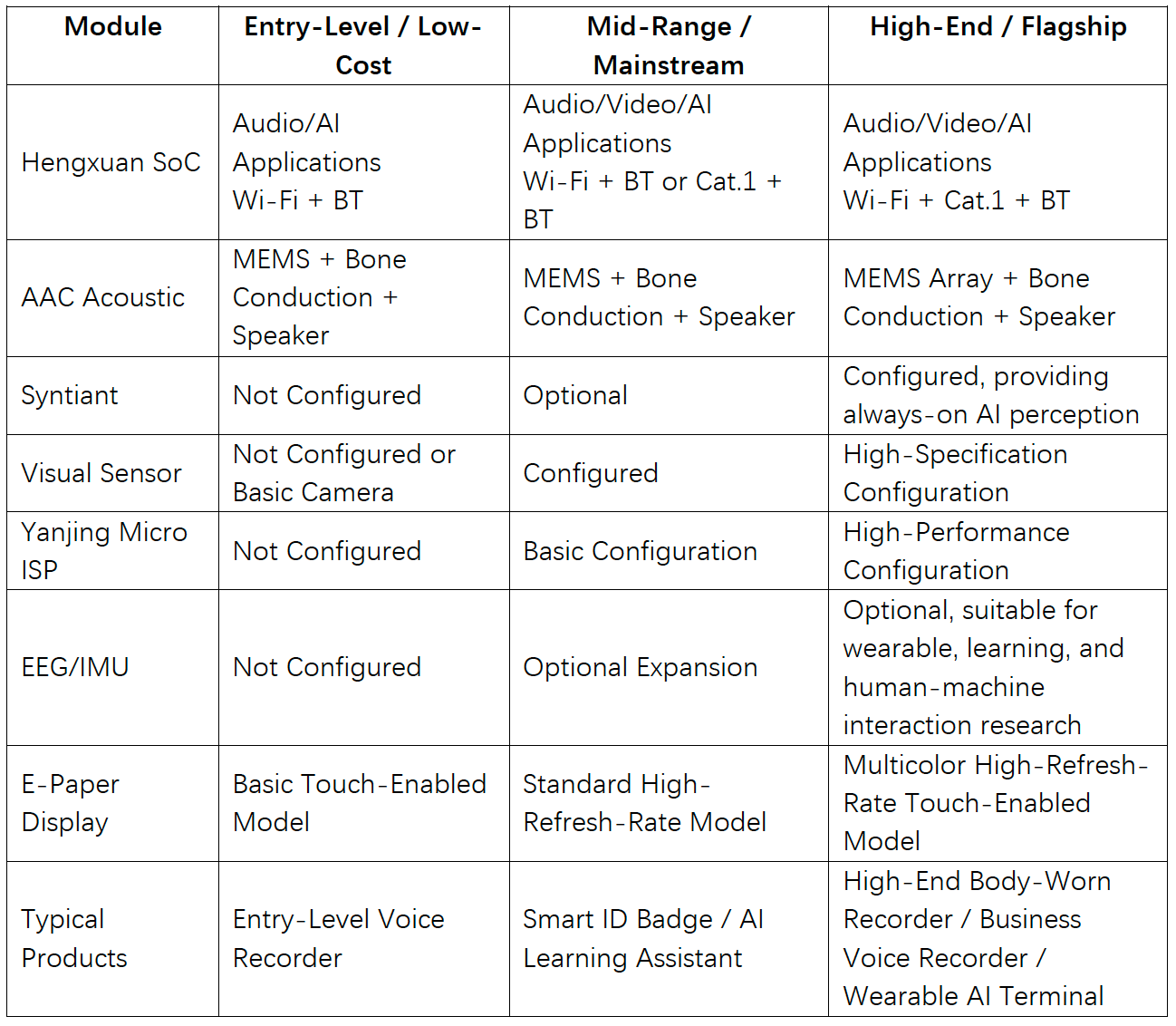
Three Typical Deployment Solutions
Entry-level / Low-Cost Solution
Built around a Hengxuan SoC and a complete acoustic chain, this solution retains Wi-Fi/Bluetooth connectivity and a basic touch-enabled e-paper display, while omitting Syntiant, a professional ISP, and EEG.
AI, recording, transcription, and connectivity functions are primarily handled by the main SoC.
This solution is suitable for cost-sensitive products focused primarily on recording and voice interaction.
Mid-Range / Mainstream Solution
Building on complete acoustic capabilities, this solution adds a visual Sensor and basic ISP to enable photography, video recording, motion detection, and local image optimization.
Syntiant and EEG can be optionally configured according to project requirements.
This solution is suitable for smart ID badges, AI learning assistants, and products requiring synchronized audio and video recording.
High-end / Flagship Solution
This solution adopts the complete hierarchical architecture: Syntiant provides ultra-low-power always-on perception; the Sensor + high-performance ISP form a high-quality visual pipeline; the Hengxuan SoC handles complex AI applications and connectivity; the e-paper display provides low-power interaction; and EEG/IMU user-state perception can be added according to the wearable form factor.
This solution is suitable for high-end body-worn recorders, business voice recording terminals, and next-generation devices emphasizing proactive intelligence and multimodal interaction.
Typical Application Scenarios
Voice Recorders and Business Recording
Automatically identify meaningful conversations and perform high-definition recording, transcription, summarization, and extraction of key action items. Low-power monitoring reduces unnecessary recording.
Smart ID Badges and Field Terminals
Continuously perceive sound and key visual information while being worn. Applications include on-site recording, task notifications, process confirmation, and documentation of abnormal events.
AI Learning Assistants
By combining voice, visual input, and an e-paper display, the device can recognize lecture content, textbooks, and learning tasks. With optional EEG/IMU, the system can explore notification rhythms and interaction methods based on attention trends.
Body-Worn Recorders
Use Sensor + ISP technology to improve image quality during movement and in low-light environments. Event-triggered recording reduces the power consumption and storage burden associated with continuous recording.
Wearable Smart Terminals
In form factors such as AI glasses, headphones, and pendants, environmental sound, visual information, movement, and user-state information can be integrated, allowing devices to evolve beyond simply “waiting for users to issue commands” toward “proactively providing value after understanding the context.”
Core Value Proposition
Lower Power Consumption
Always-on tasks are assigned to ultra-low-power components, while the main SoC is awakened only when required, improving the battery life of portable devices.
Higher Perception Quality
Professional acoustic, visual, and user-state sensors each perform their specialized functions, reducing the compromises that arise when a single chip is responsible for every task.
More Natural AI Interaction
AI can understand not only what the user says, but also combine environmental information, visual input, and user-state information to determine when it should provide a notification and when it should wait.
Faster Productization
Standardized hardware interfaces and software frameworks support module reuse and rapid adaptation across multiple products, shortening the development cycle from proof of concept to mass production.
Enhanced Data Security
A significant amount of wake-word detection, event detection, and preliminary analysis can be performed at the edge, reducing the need to continuously upload raw audio and video data to the cloud.
Stronger Platform Scalability
The same architecture can support voice recorders, smart ID badges, learning assistants, body-worn recorders, smart glasses, and other wearable devices, while allowing additional sensors and AI models to be integrated in the future.
Conclusion
Competition among edge AI terminals is moving beyond “whether a product has AI functionality” toward “whether it can continuously perceive and understand its surroundings and proactively provide value.”
Through the coordinated design of low-power AI, acoustic, visual, EEG/IMU, main SoC, and low-power display technologies, this platform provides a reusable, scalable, and mass-production-ready technology foundation for different products.
Its value lies not in installing every component into a single device, but in enabling each type of component to perform the tasks best suited to its power-consumption and computing-performance range. In this way, the platform enables the development of truly deployable multimodal edge AI products.





 Previous chapter: Application Solution Quadruped Robot Joint Drive Solution