
With the widespread adoption of cloud-based speech recognition and large language model capabilities, lightweight AI wearable recording devices are evolving from “saving sound” to “understanding the environment.” However, in mobile office work, customer visits, and on-site operations, many products still rely on a smartphone’s Bluetooth connection or Wi-Fi hotspot to upload data: when the smartphone is not nearby, the hotspot is turned off, or network access is unavailable at the site, the device can often only continue recording, causing the intelligent processing workflow to be interrupted.
To address this practical challenge, Fortune Techgroup has developed a system-level solution for cellular-connected AI PIN terminals. Through the coordinated design of a wearable audio terminal, reliable local storage, an independent cellular data connection, cloud-based AI processing, and smartphone App management, the solution enables recording to continue without relying on a network connection, while allowing AI tasks to be automatically completed once connectivity is restored. The focus of the solution is not simply to add a communications module, but to establish an engineering-ready balance among compact form factor, low power consumption, audio quality, and data reliability.

FROM “RECORDING TOOL” TO “PERSONAL INFORMATION GATEWAY”
The AI PIN can be worn using a clip, magnetic attachment, or lanyard, with a physical button used to start and stop recording. The terminal prioritizes complete audio capture and uses an independent cellular network connection to access business cloud services. The smartphone is used for device configuration, content viewing, and historical-record management rather than serving as a mandatory gateway for the terminal to connect to the network. Subject to user authorization and service availability, users can access transcriptions, summaries, key conclusions, action items, and content search capabilities.
The system design follows four principles: recording first, independent connectivity, division of responsibilities between the edge and cloud, and privacy by design. Here, “independent connectivity” means that the device does not need to continuously rely on a smartphone hotspot or nearby Wi-Fi. It does not mean that the device can access cloud services in real time when cellular coverage is unavailable or data service has not been activated. During offline periods, local recording and task caching are used to ensure continuity.
FORTUNE TECHGROUP SYSTEM-LEVEL SOLUTION ARCHITECTURE
The overall solution is organized around five layers: “audio perception — edge recording — cellular transmission — cloud intelligence — application management.” Different acoustic components, communication platforms, storage capacities, and cloud services can be combined according to customer requirements.
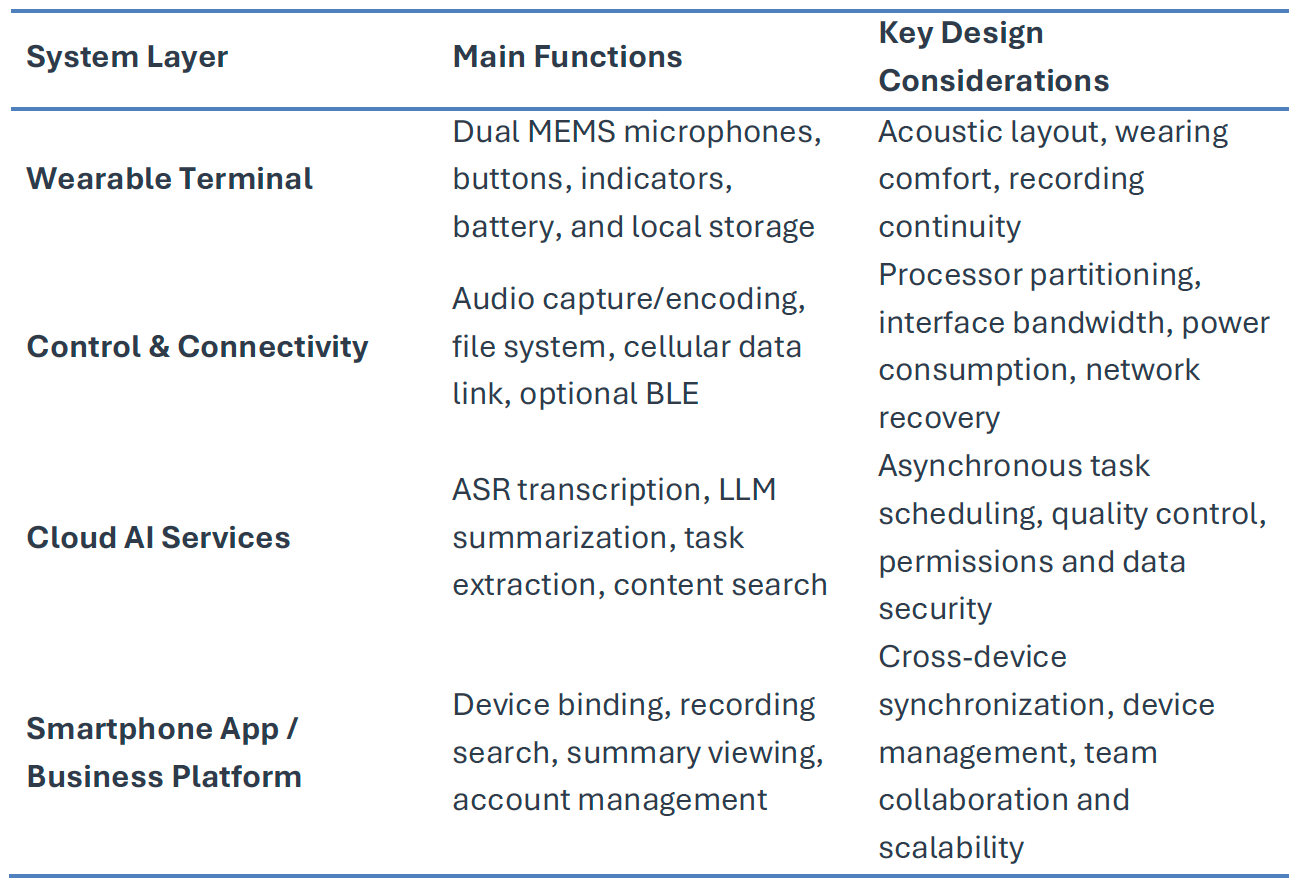
In actual product development, the cellular baseband, main controller, and BLE can adopt either an integrated or discrete architecture. Whether to add an independent audio processor should be evaluated based on chip interfaces, storage throughput, algorithm workload, and standby power consumption. Platform models and deliverable functions are subject to the configuration and validation results of the specific project.
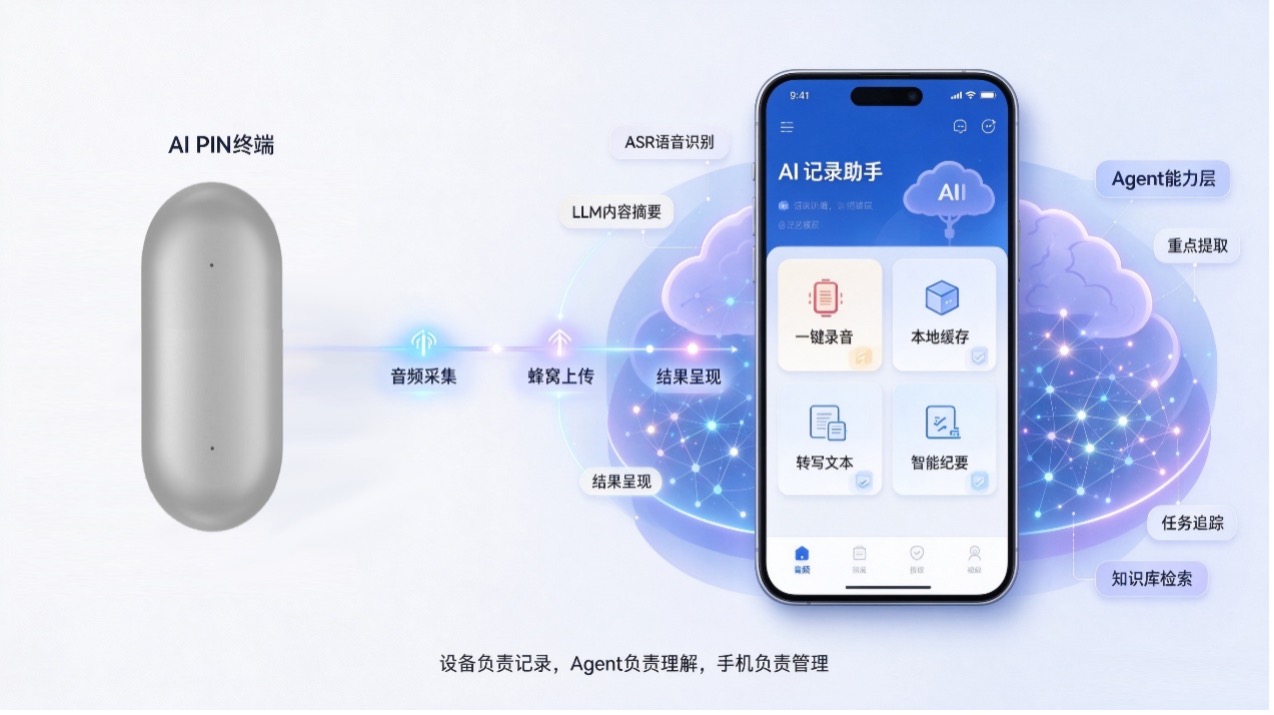
FOUR KEY TECHNOLOGY DESIGN AREAS
1. DUAL-MICROPHONE PICKUP FOR REAL-WORLD WEARING SCENARIOS
Dual MEMS microphones provide input for noise suppression and spatial information processing, but pickup performance is not determined by the number of microphones alone. The Fortune Techgroup solution adopts a coordinated design covering microphone selection, acoustic-port layout, overall device structure, gain management, voice activity detection, audio encoding, and algorithm adaptation. Particular attention is given to challenges caused by chest-mounted use, including obstruction, clothing friction, wind noise, multiple people speaking, and changes in distance.
Product validation should not focus solely on demonstrating the “maximum pickup distance.” Transcription word error rate, effective voice coverage, the impact of sudden noise, and recording stability should also be evaluated in meeting rooms, corridors, outdoor environments, and actual wearing scenarios. Test data should then be used to guide iterations of the acoustic structure and algorithms.
2. LOCAL-RECORDING-FIRST DESIGN AND RELIABLE STORAGE
The recording pipeline is decoupled from network uploading. After the user presses the recording button, audio is first written to local storage, while a file index and task status are generated. Even if the network connection is temporarily interrupted, recording can continue. The system supports file segmentation by duration or size, storage-capacity management, file-integrity verification, recovery after unexpected power loss, and archiving and cleanup strategies following successful upload.
For different market positions, a 4 GB lightweight cache version and a 64 GB high-capacity offline recording version can be planned. Actual recording duration depends on encoding bitrate, file-system overhead, available storage capacity, and battery life, and should not be inferred solely from the nominal storage capacity.
3. CELLULAR DIRECT CONNECTION AND ADAPTIVE DATA UPLOAD
The solution uses LTE cellular connectivity suitable for voice files and lightweight AI task data. The terminal can upload data in segments after recording ends or when predefined policy conditions are met. File identifiers, chunk acknowledgments, retransmission, and resumable transfers are used to reduce the impact of upload failures under weak network conditions. The cellular link also supports status reporting, task-result retrieval, and necessary remote maintenance.
Power management should not simply equate to “stop uploading when the signal is weak.” The system can consider network quality indicators such as RSRP, RSRQ, and SINR, remaining battery level, the size of files waiting to be uploaded, and task priority to determine when to establish a connection, perform batch transmission, or defer non-urgent tasks. Cellular antenna design must also take into account proximity to the human body, metal housings, wearing orientation, and frequency bands in the target region.
4. LOW-POWER STATE MACHINE AND EDGE-CLOUD TASK COORDINATION
The terminal manages power consumption across operating states including standby, recording, uploading, result synchronization, and sleep. Recording tasks are assigned a higher priority than non-real-time file uploads. The cloud uses an asynchronous task workflow. After receiving and validating a recording, it performs speech recognition, content organization, and summary generation, and then associates the processing status and results with the user, device, and recording file.
The business platform can be further extended to support speech-content search, action-item management, integration with enterprise knowledge bases, and industry work-order interfaces. Such capabilities should be deployed according to the customer’s cloud services, data permissions, and actual business requirements, with a clear distinction between core functions and optional extensions.
TYPICAL EDGE-CLOUD WORKFLOW
· The user presses the button to start recording. Dual-microphone audio is captured, undergoes necessary preprocessing and encoding, and is continuously written to a local file.
· After recording ends, the terminal completes file packaging, performs an integrity check, and creates an upload task.
· When network and battery conditions meet the configured policy, the terminal uploads data in segments through the cellular link. If the connection is interrupted, the transfer resumes according to the task status.
· After the cloud validates the file, it triggers ASR and LLM processing to generate a transcription, summary, and optional action items.
· The user views the processing status and historical results through the App and manages, shares, or deletes recordings according to their permissions.
FROM DESIGN SPECIFICATIONS TO ENGINEERING VALIDATION
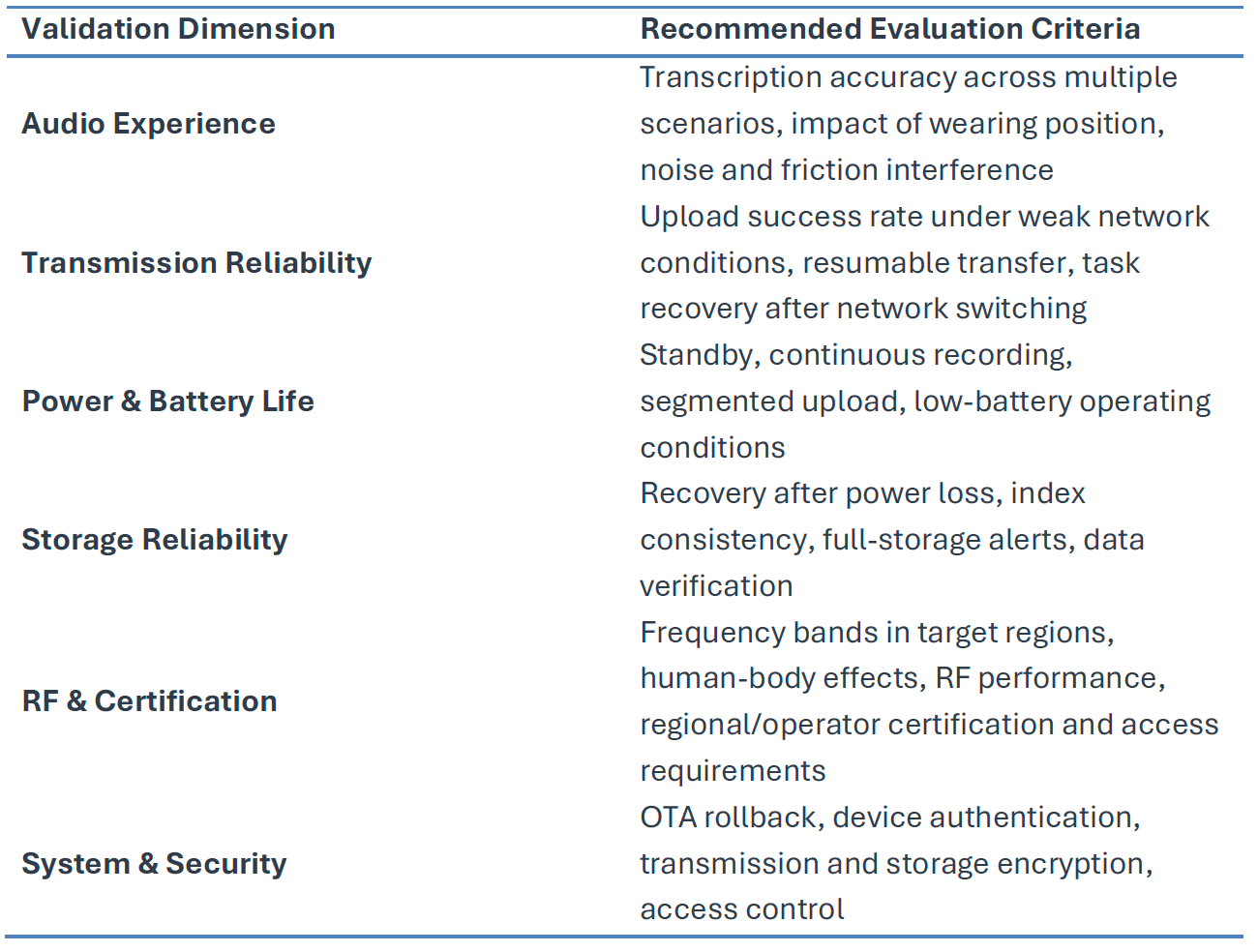
For actual projects, Fortune Techgroup recommends converting “usable, reliable, and mass-production-ready” into measurable engineering thresholds. When presenting information externally, target values, prototype measurements, and mass-production specifications should be clearly distinguished. The theoretical capabilities of individual chips should not be used as a substitute for complete-device test results.
PRODUCTIZATION FOR DOMESTIC AND OVERSEAS MARKETS
Cross-regional sales require specific SKUs to be defined based on local LTE frequency bands, operator networks, SIM/eSIM services, regulatory certifications, data-storage regions, and after-sales maintenance requirements. Adopting a mature cellular platform can help shorten component selection and debugging cycles. However, global platform support does not automatically mean that the complete device can be sold globally. Final validation must still be completed based on the module version, antenna design, local certifications, and operator requirements.
Recording terminals involve personal information and commercially sensitive content. The solution recommends incorporating recording-status visibility, necessary user notifications and authorization, transmission and storage encryption, access control, and data-retention and deletion mechanisms into the initial design. For cross-border data transfers and deployments in specific industries, further evaluation should be conducted based on the laws and regulations of the target region and the customer’s compliance requirements.
FORTUNE TECHGROUP’S PLATFORM-LEVEL SOLUTION VALUE
The key challenge in developing an AI PIN product is not a particular communications chip or a single AI model, but the coordinated optimization of acoustics, communications, storage, power, software, and cloud services. Based on its component and chip resources, accumulated audio technology expertise, and experience in terminal solution development, Fortune Techgroup organizes key component selection, hardware and software architecture design, joint acoustic and RF debugging, edge-cloud interface integration, prototype validation, and mass-production introduction support according to customer requirements. Specific services and delivery boundaries can be defined according to the scope of cooperation for each project.
This reusable design methodology can also be extended to applications such as AI smart ID badges, field-service recording terminals, and portable voice assistants. The underlying layer maintains reliable audio capture, independent connectivity, and secure data management, while the upper layer can configure different AI services according to the application scenario. Through platform-based development, customers do not need to build every functional module from scratch, allowing product teams to focus more closely on differentiated user experiences and industry-specific applications.
Conclusion
The transition from voice recording to AI assistants depends on enabling devices to reliably capture information, securely store data, independently connect to networks, and continuously transform audio into actionable information in mobile environments. With a system-level design approach, Fortune Techgroup connects terminal hardware, cellular networks, and cloud-based AI to provide a technical pathway for lightweight wearable devices, from solution evaluation and prototype validation through to productization. Looking ahead, as low-power connectivity, audio algorithms, and edge-cloud collaboration capabilities continue to evolve, AI PINs have the potential to become a more natural and convenient information gateway for both individuals and industry.





 Previous chapter: A New Era in Ultra-Low-Power Bluetooth Positioning