
For years, positioning tags have faced three major challenges: inaccurate ranging, short battery life and high hardware costs.
Traditional BLE positioning relies on Received Signal Strength Indicator (RSSI) measurements to estimate distance, providing only approximate proximity rather than reliable distance measurements. While basic Channel Sounding (CS) technology overcomes the limitations of RSSI and enables centimeter-level ranging, standalone CS requires extensive phase-correction data packets to be transmitted over the air. This increases bandwidth consumption, ranging latency and power consumption, making it unsuitable for small, battery-powered tags.
Meanwhile, UWB technology, widely recognized for its high positioning accuracy, faces challenges including high chip costs and limited smartphone ecosystem support, restricting its adoption largely to premium products.
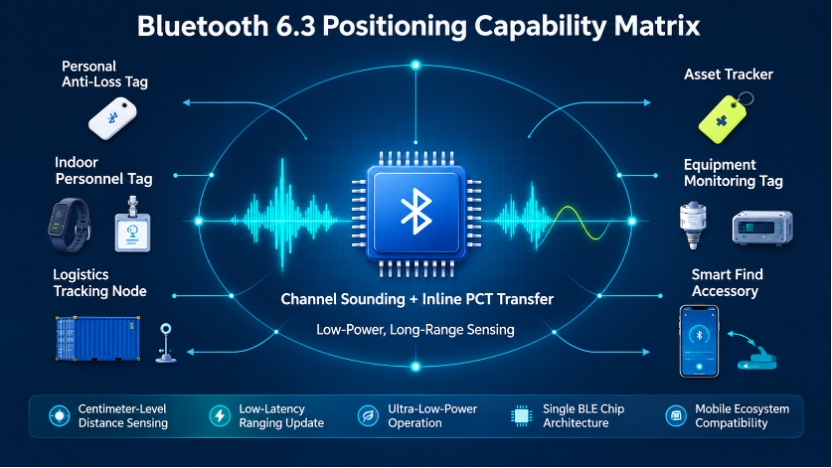
With the introduction of the Bluetooth 6.3 standard, the combination of Channel Sounding (CS) and Inline PCT Transfer (IPT) takes Bluetooth ranging capabilities to a new level.
Fortune Techgroup’s latest ultra-low-power BLE SoC series features native hardware support for these advanced ranging technologies, combined with its signature ultra-low-power performance. This delivers a new positioning solution for consumer anti-loss tags and industrial IoT asset tracking.

CS: Upgrading Bluetooth from Signal Detection to True Distance Measurement
Traditional Bluetooth positioning relies on RSSI (Received Signal Strength Indicator), essentially estimating distance based on signal strength. Obstacles and device orientation can significantly distort the results.
Channel Sounding (CS) fundamentally changes this approach. Instead of relying on signal strength, devices exchange tone signals and calculate the physical distance between them using phase shifts and Round-Trip Time (RTT). This enables ranging accuracy down to the tens-of-centimeters level, providing reliable and secure distance awareness while offering greater resistance to relay attacks than RSSI-based ranging.
However, standalone Channel Sounding also has inherent limitations.
Under the original Channel Sounding workflow, after collecting raw Phase Correction (PCT) data, the tag must transmit large volumes of PCT data packets to the peer device over the Bluetooth wireless link. The receiving device then performs phase compensation and distance calculations.
This creates four key challenges:
1. High Wireless Overhead
Large volumes of PCT packets consume Bluetooth air-interface bandwidth, competing with advertising and other communications. When data reporting and sensor interactions occur simultaneously, packet collisions may arise.
2. High Ranging Latency
Additional data transmission and reception introduce delays. In fast-moving asset and personnel tracking scenarios, distance updates may fail to keep pace with movement, reducing tracking performance.
3. Increased Power Consumption
Frequent RF transmissions and receptions, combined with local data processing, increase the workload on the tag’s RF circuitry and MCU. For small, battery-powered positioning tags, frequent ranging directly drains battery capacity and reduces overall operating life.
4. Higher Processing Requirements
PCT preprocessing relies on MCU-based software processing, placing greater demands on the chip’s computing capabilities.
In short, Channel Sounding delivers a fundamental breakthrough in enabling high-precision Bluetooth ranging. However, without complementary optimization, its adoption in low-power, battery-operated tag applications remains constrained.
This is where Inline PCT Transfer (IPT), defined in the Bluetooth 6.3 standard, comes in. It provides the key capabilities needed to overcome these limitations.
Technology Upgrade: CS + IPT for Greater Efficiency
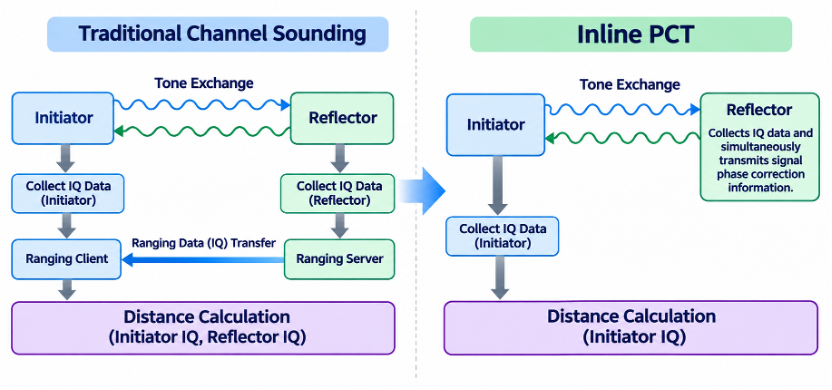
Bluetooth 6.3’s new Inline PCT Transfer (IPT) technology is key to unlocking the full performance of Channel Sounding and is a core capability natively supported by Fortune Techgroup’s latest series of ultra-low-power BLE SoCs.
Inline PCT Transfer moves phase pre-compensation into the chip’s analog front-end hardware. When the reflector receives a signal, phase alignment and retransmission are performed directly at the RF hardware level, eliminating the need to transmit large volumes of PCT correction data over the air.
This delivers three key benefits:
Reduced air-interface bandwidth overhead: Ranging no longer occupies Bluetooth communication bandwidth, allowing ranging, standard BLE data transmission and advertising to operate simultaneously and reliably.
Lower ranging latency: Eliminating data packet transfers speeds up distance updates, enabling more responsive tracking of moving people and assets.
Reduced processing load and power consumption: Lower chip processing requirements further reduce ranging power consumption, making IPT an ideal complement to an ultra-low-power BLE architecture.
In short, Channel Sounding enables accurate Bluetooth distance measurement, while Inline PCT Transfer makes it faster and more energy-efficient. Together, they enable continuous, long-term ranging for compact, battery-powered positioning tags.
Core Advantage: Ultra-Low Power Transforms Positioning-Tag Battery Life
Even the best ranging technology has little practical value for asset tracking or personal anti-loss applications if it consumes too much power and forces users to replace tag batteries frequently. The core competitive advantage of Fortune Techgroup’s new family of ultra-low-power BLE SoCs is industry-leading low-power performance.
RF reception (SoC + radio, typical): 2.0 mA; transmission at 0 dBm (typical): 3.1 mA.
Retention mode: only 2.0 μA with 128 KB of memory retained; only 2.4 μA with the full 256 KB of RAM retained.
Hibernate mode: as low as 1.1 μA; SoC fully powered off: only 300 nA.
In addition, selected devices in the family integrate an energy-harvesting controller that can interface with energy sources such as photovoltaic cells, theoretically enabling battery-free positioning tags.
Conventional positioning tags remain in sleep mode most of the time and wake briefly only to perform ranging or report data. The hardware acceleration of Channel Sounding + Inline PCT in this SoC family significantly reduces the power overhead of each ranging session. In a low-duty-cycle operating mode, a single coin-cell battery can support years of continuous tag operation, substantially reducing maintenance costs. This makes the solution well suited to industrial asset tracking, medical equipment tracking and personal-item tracking.
The chip also integrates a complete power management unit (PMU). Battery input supports wide voltage ranges of 1.1–1.6 V or 1.7–3.3 V, eliminating the need for an external power-management chip, reducing the bill of materials (BOM) and simplifying hardware design. It also incorporates an ARM Cortex-M33F processor with a TrustZone security core, AES and a true random number generator (TRNG), providing hardware-based security for the transmission of ranging data and asset information.
UWB Comparison: Cost and Ecosystem Considerations
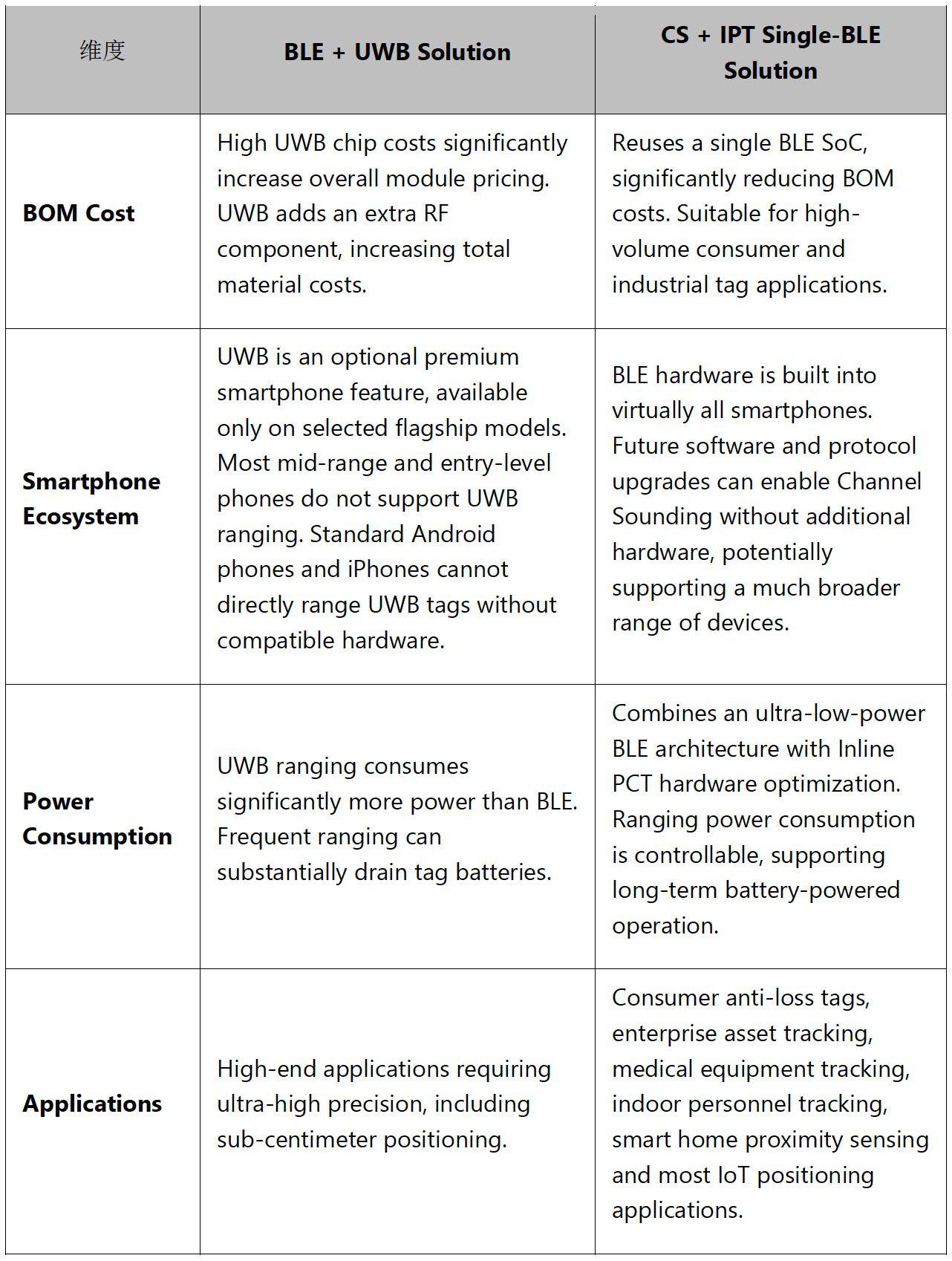
There are currently two mainstream approaches to achieving centimeter-level positioning: BLE + UWB combo-chip solutions and Bluetooth 6.3 Channel Sounding-based single-BLE solutions. They differ significantly in cost and smartphone ecosystem compatibility.
The Next Era of Bluetooth Positioning
For years, Bluetooth positioning has been caught between inaccurate RSSI-based ranging and the high cost and limited ecosystem of UWB.
Fortune Techgroup’s latest ultra-low-power BLE SoC series combines industry-leading low-power performance, Channel Sounding (CS) and hardware-level phase correction through Inline PCT Transfer (IPT).
By eliminating the need for additional UWB RF components and leveraging the widespread BLE ecosystem, high-precision ranging can now reach mass-market consumer tags and large-scale industrial asset tracking applications.
As the technology continues to evolve, Channel Sounding performance will expand with broader smartphone adoption. UWB will remain an important complement for applications requiring extreme, sub-centimeter accuracy. However, for most IoT positioning tags, low power consumption, cost efficiency and compatibility with a broad range of smartphones are the key foundations for large-scale commercial adoption.





 Previous chapter: None